
DASR - Safety Management System

The Defence Aviation Safety Regulation (DASR) - Safety Management System (SMS) implementing regulation is part of the Defence Aviation Safety Framework (DASF) for the definition and implementation of common safety requirements and administrative procedures in the field of military aviation. DASR SMS codifies Defence’s moral and legal obligations to ensure risks to health and safety or personnel arising from military aircraft operations are eliminated or otherwise minimised So Far As is Reasonably Practicable (SFARP), based on the Commonwealth Work Health and Safety Act 2011.
An SMS is a systematic approach to managing aviation safety, including organisational structures, accountabilities, policies and procedures. An effective SMS improves an organisation’s capability of predicting, preventing and treating aviation hazards and risks.
The following sections detail the DASR SMS background, components and elements, oversight methodology, requirements for organisations, training and resources.
The DASA SMS mailbox (dasa.asms@defence.gov.au) is available for SMS related enquiries.
DASR SMS Implementing Regulation: Background

SEC/CDF Joint Directive 24/ 2016 (extended by JD 21/2021) established the DASF and acknowledged the benefits and efficiencies afforded through adoption of global conventions and practices.
The structure of DASR SMS aligns to the International Civil Aviation Organisation (ICAO) Chicago Convention Annex 19 framework and includes consideration of the Commonwealth Work Health and Safety Act 2011. Most National Aviation Authorities (NAA) considers the ICAO framework as best practice and has extensive supporting guidance material available for regulated entities.
Which organisations require an SMS?
An organisation’s requirement to comply with DASR SMS is invoked from other regulatory requirements under which an organisation is seeking approval. Organisations requiring an SMS include:
| Military Air Operators | DASR AMC ARO.100(d) |
| Continuing Airworthiness Management Organisations | DASR M.A.712(g) |
| Production Organisations (21G) | DASR 21.A.139 & 143 |
| Design Organisations (21J) | DASR 21.A.239 & 243 |
| Air Cargo Delivery | DASR ACD.40 |
| Aerodrome Operators | DASR 139.60 |
| Maintenance Organisations | DASR 145.A.65(f) |
| Air Navigation Service Providers | DASR ANSP.40(a) |
| Military Type Certificate Holder | DASR 21.A.76(d) |
SMS Regulations
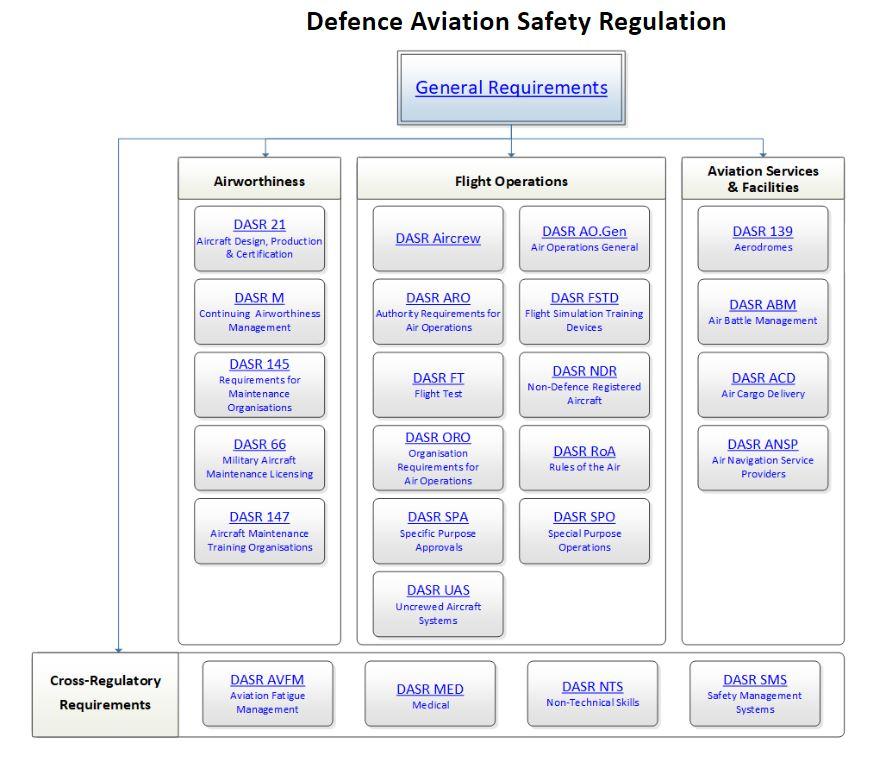
Integrated Safety Management Systems

DASA does not require the integration of management systems with the organisation’s SMS, but acknowledges the benefits and efficiencies of integrated management systems. The organisation may choose to integrate other management systems, WHS Management for example, achieving best use of resources and realising organisational efficiencies.
DASA Oversight and Enforcement

DASA promulgates the DASA Assurance Safety Schedule (DASS) to the Defence Aviation Safety Community (RC) during Quarter 4 of each year— proposing timings for DASA oversight and enforcement activities. DASA conducts assurance activities on an organisation’s SMS to determine compliance and conformance with DASR SMS through the organisations SMS published and endorsed plans and procedures. Additionally, DASA assesses the effectiveness and performance of an organisation’s SMS using to the Present, Suitable, Operation and Effective (PSOE) methodology. DASA considers the organisation’s size, the nature of their operations and complexity of the organisations aviation products or services when undertaking an SMS oversight and enforcement activity.
The PSOE methodology is an internationally recognised model to assess:
Present - There is evidence that procedures, processes and competencies are clearly visible and documented within the organisation's SMS
Suitable - There is evidence that the procedures, processes and competencies are implemented and maintained within the business undertaken and appropriate based on the size, nature and complexity of the organisation
Operating - There is evidence that the procedures, processes and competencies are being used IAW the documented SMS
Effective - There is evidence that the procedures, processes and competencies are effective and achieving the desired outcome for the organisation
Organisations are encouraged to contact DASA to gain understanding or clarification on their safety requirements under the DASR SMS. DASA uses the SMS PSOE Evaluation Tool to assess an organisation’s SMS compliance.
Discoveries and findings from previous oversight and enforcement activities inform future SMS evaluation focus. Oversight and enforcement results form the basis for acceptance and continued organisational approvals and authorisations issued by DASA.
SMS PSOE Evaluation Tool

The Safety Management International Collaboration Group (SMICG) SMS evaluation tool forms the basis for the SMS PSOE Evaluation Tool. The SMS PSOE Evaluation tool is further refined and adapted for the Australian Defence aviation domain. This adaptation includes terminology harmonisation and inclusion of the DASR AMCs cross-references to evaluation indicators.
DASA’s intent is to maintain ICAO alignment and pursue collective international best practice towards aviation safety. This will ensure a credible and defensible approach to SMS evaluation.
The following link to the SMS PSOE Evaluation Tool for the new regulation:
Component 1 - Safety Policy and Objectives
Component 2 - Safety Risk Management
Component 3 - Safety Oversight and Improvement
Component 4 - Safety Promotion
The following link to the SMS PSOE Evaluation Tool for the previous regulation:
SMS Documentation

Through DASR SMS, DASA details 'what' is required of an organisation's SMS. Organisations develop 'how' they will achieve compliance and conformance with DASR SMS. An organisation may elect to demonstrate compliance through documentation, such as an SMS Exposition or Standing Instruction, providing a central location where compliance with DASR SMS is clearly summarised and referenced. Listed below are some options for an organisation to arrange their SMS.
Produce a stand-alone Order, Instruction or Exposition with all associated documents and procedures contained or referenced within.
Enhance the aviation safety section of existing safety Orders, Instructions or Expositions demonstrating compliance with all elements of DASR SMS.
Create a short document containing overview paragraphs for each element and references or hyperlinks to source documents.
Create and maintain a webpage containing all references, forms and documents as hyperlinked items—including overview descriptions of how the system operates.
SMS Documentation includes all policies, procedures, manuals, forms, records associated with your organisation’s SMS. Examples of SMS Documentation include:
Hazard register(s) - containing aviation safety hazards
Risk register(s) - containing aviation safety related risks
Hazard identification form(s)
Risk assessment form(s)
Training register(s) - containing aviation safety related training
SMS promotion material
SMS meeting minutes
Organisational safety structure
Safety Policy Statement(s)
Safety Objectives/Targets
Aviation safety schedule of events
Management of change risk assessment(s)
Implementation Plans
SMS documentation review notes
Investigation process templates
Audit/Survey/Assessment form(s)
SMS Regulated Community engagement 2025/26

The 01/25 Defence Aviation Safety Board approved a 12-month pause to DASA oversight and enforcement activities for MAOs, commencing June 2025. This is a result of direct DASA observations of the DASC and DASC feedback. In place of MAO oversight, DASA will conduct an SMS and QMS review to assist MAOs to improve understanding and compliance, on non-jeopardy agreement, with SMS and QMS requirements.
DASA is conducting SMS Town Halls to engage the safety community to provide regular updates and opportunity for Q & A. Previous SMS Town Hall recordings, transcripts and FAQs are available below:
2026 SMS Town Hall Presentations
| Mar | Apr | May | Jun | Jul | Aug | Sep | Oct | Nov |
For 2026 SMS Town Hall recordings and transcripts please contact dasa.web@defence.gov.au
DASA has also the DASM to DASP Manual Volume 2 and 3 Cross Reference chart below:
SMS Training

DASA delivers the SMS Practitioner Course (216450) approximately eight times per year—as per the DASA Training schedule. This course is a prerequisite to ASO(I) course, delivered by DFSB, and SMS Assessor course, delivered by DAVNOPS SMS. The course target audience includes members who fulfil, perform, or enable Aviation Safety Manager functions. For further details, see the SMS Practitioner and SMS Assessor course information sheet on the DASA Training webpage.
The SMS Training and Education Matrix provides the training requirements for Aviation Safety roles and positions.
Changes to DASR SMS

As part of an organisation's SMS, the organisation should strive to continuously improve. DASA encourages the DASC to submit suggestions for improvement to DASR SMS regulations, Acceptable Means of Compliance (AMC) and Guidance Material (GM) through submission of a DASR Change Proposal - Form 111. This form is found in DASR Forms and Templates | Defence Aviation Safety Authority.
Resources
Further information on SMS is contained through the list of links to documents and resources provided below. These materials are for guidance only and do not replace the regulations.
Joint Directive 21/2021 The Defence Aviation Safety Framework
ICAO Safety Management Manual(Opens in a new tab/window) (ICAO Doc 9859, 4th ed.)
CASA Safety management system resource kit(Opens in a new tab/window)
DOC10159 Safety Intelligence Manual(Opens in a new tab/window)